



Your basket is empty

The opening track of the Ecstatic Computation album, re-imagined by eight friends and long-time collaborators.
‘Kali Malone turns in a slowed-down, austere and eerie version for two Organs; Evelyn Saylor a vocal ensemble conveying its choral, psychedelic and vitalistic nature. Walter Zanetti composes Fantas for electric guitar. Bendik Giske’s reinterpretation for saxophone and voice captures its atmosphere and its psychic meteorology. Carlo Maria resynthesizes for TR808 and MC202, with an eye on the dancefloor. Jay Mitta’s Singeli pitches up the percussion, unleashing the frenetic, shifting matter within the original into euphoric dance. Baseck’s variation is a hardcore rave fantasia; whilst Kara-Lis Coverdale’s take is a phantasmagoria for piano that gently, yet inexorably, captures the relentlessness chimerical qualities of the original, unveiling its spectral backbone.’

Perhaps you remember the French music producer Coni’s record for The Trilogy Tapes.
For the inaugural release of his own label, he presents the debut of a new alias.
‘Inspired by dramatic modern landscapes, and suffused by haunting memories, the record is an attempt to seek beauty in the midst of a chaotic and saturated present. Running over with intense rhythms, flicking hi-hats, fierce voices, melancholic pads and abject distortion, Transperce whips up a kind of industrial catharsis.’
Wow!
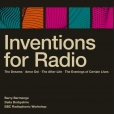
‘The BBC’s Third Programme aired four radio broadcasts between January 1964 and September 1965, collectively known as Inventions for Radio. Conceived by playwright Barry Bermange they consisted of the voices of the general public answering questions on four themes, one for each programme: dreams, the existence of God, life after death, and ageing. The Dreams, Amor Dei, The After-Life, The Evenings of Certain Lives. Delia Derbyshire was assigned by the Radiophonic Workshop to edit and add electronic music/ effects. The collaborative result is dreamlike and mesmerizing.’
Including one LP for each broadcast, and two further LPs of additional material, together with a twenty-page booklet, housed in a lidded box.

‘The opener is a statement of intent — frazzled, shuffling drums, ketamine oud, heavy sub bass — something like Wordsound’s Scarab zooming out of the 90s into the future. Tombaroli is a head nodder, with insistent percussion and banging pulse. A lysergic fever-dream, Bullet Holes dips into spooked psychedelia; No Minus sounds like a distant cousin of DJ Premier’s production Come Clean, for Jeru.
‘Channel 83 lands us back in the club for a rib-rattling stomp, weaving mystical soundsystem magic with its stunted horns and swirling voices. The grimy judder of Expect Excerpt slides proceedings down to a bleary-eyed half-speed, like a party which won’t let you leave. Mount Point is a welcome release, an early morning sunrise — rich, slow, and shimmering — before Landings Dub signals the end of the journey with a metallic elegy; both a summing up of the record, and the contemplation of your flipping it, and re-entering the world of Detraex Corp.’
Astounding, deeply exploratory, previously unreleased work by the legendary Brazilian percussionist and composer.
A wild and unsettling collage, implacably original and startlingly intense — from the electroacoustic opener, which channels ancestral African inspirations into cosmogony, through the proto-mixtape Exemplo de Sintetizadores, which transitions from transcendental drones to astral cha-cha-chas, to a musical consideration of dripping water, in Suite Contagotas.
Djalma is best known for his studio work on benchmark albums, including numerous classics by Caetano Veloso, Gilberto Gil, and Jorge Ben, and for his own polyrhythmic opus Baiafro; and the finale here was first performed at the 1964 Nós, Por Exemplo concert, an event often cited as the inauguration of the Tropicalia movement. Djalma brings the electronics — medical oscillators, for example — to beef up his percussion. It’s eye-opening.
Corrêa called it ‘spontaneous music’; sonic adventures ranging audaciously across an array of genres, from jazz to deep funk to complete abstraction, all imbued with his signature DIY ethic.
Drawn from the original master-tapes, guided by Corrêa himself, just prior to his death.
Intriguing, immersive music. Dazzling, engrossing artwork, too.
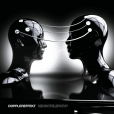
You can hear their stage experience in ‘the sizzle and swing of the percussive highlights here, programmed with a serious depth and wriggle that reflect both an extension of and return to form. Considerations of the machine-human interface, neurological realities and physical probabilities dominate. But these tracks are economical and precise, glittering with emotional depth and cinematic effects. The album’s core, a three-act movement of symphonic uncertainty and revelation, marks one of the pair’s most evocative compositions in a career full of them.’

‘Further adventures in Organic Electronic Music by this rigorous magician of vaporous, oscillating patterns, sidereal frequencies, nebulous dust; explorer of inter-zonal paths, new dreamlike dimensions, undiscovered planets. Marrying the momentum of Kraut-Kosmische with a personal, gentle minimalism, DSR Lines specialises in rare atmospheres of rhythmic pulsation, with enveloping, spiralling sounds, luminous and radiant in their hypnotic aura, or magnificently ecstatic and ascending.’

This stylish, devoted, two-hundred-plus-page book is based around a deep, fascinating interview, covering the work in detail, but with naturalness and directness; also Radigue’s life, milieux, aesthetics and methods, politics, and so on. There are numerous choice photos; a few precious sketches, flyers and diagrams. The oeuvre is listed, with commentaries. All texts are in both English and French, beginning with her prose poem The Mysterious Power of the Infinitesimal. Pretty much indispensable, if you’re at all interested.
‘Eliane Radigue and I decided to resume our conversation and come up with this expanded second edition of the book. Much had happened since the first edition that deserved to be explored in more depth, in particular the development of the Occam Ocean cycle. But I also took the opportunity to ask her questions about her earlier work that had not been addressed previously. The first four parts of this new edition remain unchanged, but they are now followed by an epilogue. The lists of works and publications have also been updated and extended’ (Julia Eckhardt, December 2023).