









Your basket is empty

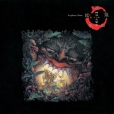
‘One of the most innovative and ambitious albums ever made; a sonic masterpiece featuring over two hundred musicians, which expanded the limits of music and sound, channeling Ōhashi’s thinking about mankind’s relationship with nature, and fundamental questions of life, death and rebirth… Pipe organ synths made from sampled Tibetan horns sit alongside field recordings from Central African forests, Buddhist mantras circle dummy head microphones, Javanese Jegog percussion ensembles pulse like verdant ecosystems, and the acoustics of temples, caves and landscapes are conveyed in the mix. Weaving together culture, nature and technology, it is a record that vibrates with the polyphony of life on Earth… But Ecophony Rinne was not only musically innovative. Noticing the difference between vinyl and CD versions of the album where digital reproduction limited the sound, Ōhashi developed a theory of Hypersonic Effect, determining that ultra-high frequencies above 20khz can impact human perception even if they are inaudible. At once a physical and a psychological experience, to listen to Ecophony Rinne is to feel music differently.’
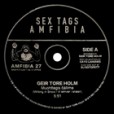
Flexidisc.

‘Ghost musick… operating in the margins and intersections of folklore, experimental electronics, dreams and nightmares… Think of it as a rampant yearning, a manic laughter, but mostly as a feeling of some somnambulistic thirst for adventure and journeys into the unknown, a feeling that is grounded deep inside the heart of the continent.’
‘Shines a light on a little-heard, spooked German underground, working below the radar on mostly small-run releases. Lower Franconia’s Baldruin lays the mystery on thick, his fevered tracks here using flutes, electric organs and shaken children’s toys to create an opaque ambience. Close neighbours Brannten Schnüre voyage into similarly uncharted territory, providing laceworks of fragile folk melodies and sloshes of breathy drone offset by detached vocals. Like Brothers Grimm armed with analogue synths, Freundliche Kreisel supply the title track’s sinister fairy tale, while the oblique textures of Kirschstein’s mystically-themed efforts betray roots in Amon Düül’s hallucinogenic psychedelia and Novy Svet’s neo surrealism. A very dark delight’ (Mojo).

‘10/10… fucks your brain so hard you’ll feel like a vegetable afterwards’ (Vice).
With guests including Mark E. Smith, Dalek, Steve Beresford and Sensational.

Drawing inspiration from Sarah Davachi and Kali Malone, six glacial minimalist drones in contemplation of Body and Soul, ecological collapse, and the nature of listening, played on the oldest functioning pipe organ in the world, built in 1435, at the Valère Basilica in the Swiss Alps.
“What I like about the organ is that you can make it feel very physical. It has all these mechanical parts that sound really beautiful.”
Litho cover; riso insert. Tiny run.
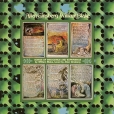
The first disc presents the original MGM LP, with Ginsberg accompanying himself on piano and harmonium, supported by Don Cherry, Elvin Jones and Bob Dorough amongst others, in twenty-one vocal settings of Blake’s Songs Of Innocence And Experience. Plus an alternate take, as well as a song intended for the LP, but left off due to time constraints.
A couple of years later, in 1971, Ginsberg returned to the Blake material, recording eleven songs in San Francisco with none other than Arthur Russell. The ensemble also recorded three Tibetan mantras with a Buddhist choir. All on the second disc.
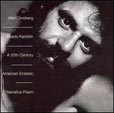
The 1964 recording of AG’s poem for his mother Naomi, fuelled by morphine, meth… and Ray Charles’ I Got A Woman on repeat.
Red vinyl, in its original gatefold packaging, with an added inner sleeve featuring new liner notes, and memorabilia provided by the Allen Ginsberg estate.
The classic session plus eleven previously unissued performances, featuring contributions from Bob Dylan, Happy Traum, Don Cherry, Peter Orlovsky, Arthur Russell and co, in a luxuriously turned out 28-page colour booklet with rare photos and new essay by the producer Pat Thomas.
John Hammond was chuffed by the original release of The First Blues in 1983: ‘I recorded Allen in 1976 but Columbia Records refused to issue the results, considering the songs obscene and disrespectful. I am thrilled to finally be able to present Allen… I will present ‘disrespectful’ music like this as often as possible.’