
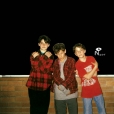










Gonzalo Benitez and Luis Alberto Valencia were kingpins of the musica nacional movement in Ecuador. Check them out on the cover, on a rooftop in Quito’s Old Town, surveying their dominion.
In 1970, when Valencia collapsed onstage during a performance of the yaravi Desesperacion — ‘My heart is already in ashes’ — and died four days later, aged 52, his coffin was carried through those city streets on the shoulders of a throng of his fans.
They began singing as a duo in their mid-teens. During twenty-eight years together they recorded more than six hundred songs, for Discos Ecuador, Nacional, Granja, Ortiz, Rondador, Onix, Fuente, Real, Tropical, Fadisa, RCA Victor — and of course CAIFE.
Their exquisitely romantic harmonising is a sublime blend of collected forbearance and abject self-annihilation, underpinned and elaborated by the heart-piercing, improvisatory guitar-playing of Bolivar Ortiz. Effectively the third member of the group. ‘El Pollo’ sets the tone and intensity for everything that follows: listen to his soloing at the start of our opener, Lamparilla.
Musically a pasillo — a cross between a Viennese waltz and the indigenous yaravi rhythm — Lamparilla draws its verses from a poem by Luz Martinez from Riobamba, written in 1918 when she was 15, under the influence of Baudelaire and Mallarme. Another pasillo here, Sombras (‘Shadows’) is one of the best-loved songs in the musica nacional canon, setting poetry about undercover sex and lost love by the Mexican poet Maria Pren, which was considered pornographic on publication in 1911. ‘When oblivion comes / I will lose you to the shadows / To the hazy gloom / Where one warm afternoon I laid bare my unbridled feelings for you / Never again will I search out your eyes / Or kiss your mouth.’
And Benitez & Valencia looked back still further, to the indigenous roots of Ecuadorian music, as the key to its future. Carnaval de Guaranda is their take on a song dating back to the era of the Mitimaes, a broad group of Bolivian tribes conquered by the Incas and displaced to Ecuador. ‘Impossible love of mine / I love you for being impossible / Who loves what is impossible / Is the truest lover.’
Fiercely beautiful, desolate music from the shadowy mists of time, the lip of oblivion, for anyone who had a heart, for anyone who ever dreamed.
Playing Alice Coltrane’s very own, restored harp, leading her longtime trio of Rashaan Carter on bass and Alan Mednard on drums (with contributions by Shabaka, Meshell Ndegeocello, Makaya McCraven, and co).
“We’ve all spent the past two or three years on the road and so there’s a personal and musical familiarity when we come to record together. Since Rashaan also produced the album and we decided to record it all at my home, it created a comfortable intimacy that kept us honest, since there was no one else there except for us. It produced spontaneous improvisations on tracks like Reckoning and Discernment, which came about entirely in the moment. While on End Means I had the time to decide on using an extended technique on harp, which muffles the string like a kalimba. You hear those moments come through far more on this album than any others I’ve created.”
“Everyone who featured on the record came through organically and it all fed into the overall theme of the album, which is playfulness. The gadabout is someone who is looking for happiness and that’s something I’m always trying to do with my band, especially when we’re exhausted and on tour! Ultimately, this is an album about finding joy throughout the journey, which is something everyone can relate to.”
Thirteen feeling, liquid synth explorations, rooted in ambient, Balearic and Kosmische; melodic, tremolo waves and rhythmic, organic vibrations, attuned to the more blissed-out, ambient fall-out from E2-E4… and of course to Ruscha’s own paintings.
“I really love when music forces you to forget,” he says. “There’s this beautiful moment where everything coalesces, and you just don’t think about anything.”
Refreshing, transporting music.