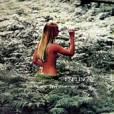
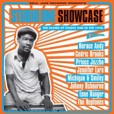

Underground soul and funk from early-seventies LA — Henry Porter, Jechonias Williams and co, with one foot inside the Watts 103rd St. Rhythm Band — lovingly unearthed by Now Again.
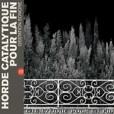
‘Lo-fi, primitive orchestral pieces for a Swedish TV-documentary series that in the end never was finished. Someone said, If the Penguin Café Orchestra would’ve used old rhythm-boxes and recorded rough demos influenced by Moondog, then this would’ve been it. That’s not true, but it’s still a hell of an album. Unique and warm. And in totally gorgeous sleeves… Old album covers have been remade and glued and etched on with the old artworks shining through here and there.’
Thrilling, angular hard bop, impatiently itching itself open to the new thing.
Dolphy plays b-flat clarinet and alto; Ron Carter plays cello. Booker Ervin is rawly eloquent as per. The seven compositions are all by Waldron, who centres proceedings with inimitable brilliance.
Feelingly recorded by Van Gelder in the summer of 1961, in the same few weeks as Ron Carter’s Where.
In this iteration — all-analogue remastering from the master-tapes, tip-on sleeve, first-class pressing — it’s a must.
A danceable version of her co-composition with Arthur Russell, In The Light Of The Miracle — retaining trombonist Peter Zummo, and adding a mix by Gifted & Blessed. White vinyl; limited.
Recorded in 1974, at the Royal Hotel in Luton, with Braxton playing soprano and alto saxophones, and Bb and contrabass clarinets. Two volumes were planned; only one was issued, till now. This was an early transatlantic meeting between leading free improvisers. Many of Braxton’s signature techniques and ideas were gestated in such sessions. It still brims with inquisitive musical creativity and knockabout jazzbo allusiveness.
‘Illustrating not only the distinctive arts of the older unaccompanied fiddlers but also the way in which the tradition is moving forward today.’
The legendary Gaelic concert singer, drawing on his vast repertoire — much of it learned traditionally, within the family circle.
Strathspeys, reels, slow airs, marches, waltzes and jigs from five different regions of Scotland, played by Hugh Inkster, Pat Shearer, Andrew Poleson, Donald MacDonell and Hector MacAndrew.
Awe-inspiring 1950s recordings by one of the greatest bagpipe players of the century… from the Isle of Mull.
Iain Ballamy and Thomas Strønen, joined by Christian Fennesz. ‘Powerful grooves, evocative textures and exploratory improvisation, sometimes hypnotically insistent, sometimes turbulent.’
‘Heavier, drier, connecting more with how we actually sound live,’ says Strønen.
Surely there’s a word missing from the sub-title. Ivan was terrible; Coxsone wasn’t downbeat. Coxsone was the Downbeat Ruler, with the Downbeat Sound System, spinning fabulous tunes like these.
An embarrassment of musical riches here, still.
Out of all the twelves by MN on Jamal Moss’ Mathematics label, maybe the most outstanding goes under the name Ra Toth — and true to form this is double-sided trumps for BH, slapping together bad-minded, cosmic jazz and banging, bruk-up disco.
The A sounds like a young Pete Rock giving Theo a hand with some Dirty Edits; the flip like a blend of evilous Arkestra and prime Innerzone Orchestra.