




Your basket is empty


LRB 45s
Volume 1
London Review of Books
Edwin Morgan read by Dominic West, Mahmoud Darwish read by Khalid Abdalla, and Jorie Graham read by Adjoa Andoh.
A handmade box-set, with a forty-page photographic booklet, in a numbered, limited edition of just 360.
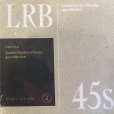
A new recording of Tony Harrison’s v., read by Maxine Peake.
A handmade box-set, with a 32-page photographic booklet, and an art print, in a numbered, limited edition of just 360.
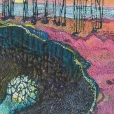
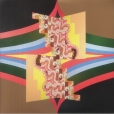
‘Dora’s signature, sublime, open-hearted refinement of modern classical, folk and ambient is at its most colourful and rhythmic in this suite of keyboard instrumentals; an aural mille-feuille, in dramatic contrast with her previous, melancholic vocal works.
‘Atmospheric drone miniatures underpin flowing, cyclical arpeggios, spiralling into an unpredictable dream space of melodic polyphony. Drawing on an essay by Hartmut Rosa, the music mulls over conceptions of the acceleration of time and the experience of alienation. It reveals the inescapable pulsation of time as at once mesmerizing and unsettling.’
A piano quintet composed for and recorded by Apartment House.
‘The instruments are muted and heavily prepared. Players are instructed to perform very quietly with an exaggerated flautando, using as much of the bow as possible while producing minimal sound. Sheen often even asks them to mime. The result is an unsettling disconnect between the intensity of physical exertion and the sound produced’ (Ed Cooper, VAN).
‘Press moves with grossly impoverished intent… trembling and stumbling on the cusp of accident… right on the edge of culture, just before language. Most of the time, it is enough simply to breathe and move: the complexity of these actions alone is astonishing… And then, through the buzz of wood, guts, and bluebottles, a piano appears—all shining lacquer, muscle, and grammar’ (Ed Atkins).
“When people play my violin pieces, I always joke with them that when you start playing them, the audience should feel like they’ve gone deaf or something. The sound is so not there that you should think there’s something wrong for a second…
“It’s so disappointing when you see a bunch of instrumentalists walk on stage and you already know how the piece is going to sound. It’s not what music is about for me…
“The word ‘liminal’ is such a cliché but it’s annoyingly pertinent for my music. Trying to find a sweet spot between states: in between presence and not presence, in between tonality and not tonality, whatever that is, between noise and pitch. I really want things to sit in an uncertain middle ground between everything.”

‘What does it mean to listen? I mean, really to listen to the infinite possibilities of every moment of our sonic lives? No composer in 20th and 21st century music asked the question more sensitively, or more profoundly than Eliane Radigue, who has died at the age of 94.
‘Radigue was a sonic pioneer. Pre 2001, her music was made exclusively for synthesisers, because the technology allowed her to get inside the world of sound, stretching individual pitches into seeming infinities of slowness and concentration, in a way that traditional composition didn’t. Listen to the epic scales of ever-changing changelessness — a paradox that makes sense when you encounter her music — of her Trilogie de la Mort to experience what I mean. As Pascal Wyse wrote in his interview with her, Radigue’s use of synthesisers meant that ‘the music didn’t contain sound: the sound contained the music’ (The Guardian).
‘One of the most innovative and ambitious albums ever made; a sonic masterpiece featuring over two hundred musicians, which expanded the limits of music and sound, channeling Ōhashi’s thinking about mankind’s relationship with nature, and fundamental questions of life, death and rebirth… Pipe organ synths made from sampled Tibetan horns sit alongside field recordings from Central African forests, Buddhist mantras circle dummy head microphones, Javanese Jegog percussion ensembles pulse like verdant ecosystems, and the acoustics of temples, caves and landscapes are conveyed in the mix. Weaving together culture, nature and technology, it is a record that vibrates with the polyphony of life on Earth… But Ecophony Rinne was not only musically innovative. Noticing the difference between vinyl and CD versions of the album where digital reproduction limited the sound, Ōhashi developed a theory of Hypersonic Effect, determining that ultra-high frequencies above 20khz can impact human perception even if they are inaudible. At once a physical and a psychological experience, to listen to Ecophony Rinne is to feel music differently.’
Two spellbinding extended improvisations referring to meteorological and planetary phenomena: evocations of light, wind, clouds, and tidal cycles as shimmering, roaring, rubbing, coalescing and diverging environments of sound; consistent and yet in perpetual flux. The quartet’s signature, singular, honed minimalism subsumes flashes of chaos into winding paths of musical detail; hushed but suspenseful.
Quietly ravishing, stunning music from Norway, by trumpeter Torstein Lavik Larsen, double bassist Adrian Fiskum Myhr, guitarist Fredrik Rasten, and drummer Jan Martin Gismervik.
Gorgeously presented, in a tiny run.
Warmly recommended.
Something else.
Spectral, nostalgic, highly evocative, sometimes-desolate reflections — alone on the piano, and together with saxophonist and flautist Finn Peters — soaked in Satie, Ravel, and Mompou. Expressive and enchanting, but mournfully distracted, with a tentative, exploratory wonderment which reminds you of Paul Klee’s well-worn idea of a drawing as a line taking a walk. Easy to recommend to those of you who recently enjoyed Mashu Hayasaka’s Etudes LP, on All Night Flight. This is lovely stuff from Jesse, in an unexpected departure from his work with Elmore Judd, the Gorillaz, Nyege Nyege Tapes…

‘To start with, disorientating; something you can’t quite grasp. Further listening discerns a futuristic, unsteady metropolis. At times, the music is soft and expansive; at others, sharp and distorted. Folk and pop sensibilities emerge, suspensively. Voices thread in melodic, indistinct, sirenic messages, guiding us through.’
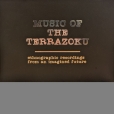
‘Mariolina Zitta began working with natural sounds at the end of the 1980s, developing a passion for speleology. Her encounter with Walter Maioli was fundamental, guiding and influencing her definitive research into sound archaeology and the primitive sources of musical acoustic phenomena. In these recordings Mariolina conducts a magical ritual as a cave priestess, celebrating the icons par excellence of the mysteries of the night: bats. The specific frequencies of the calls of these fascinating creatures are recorded with special detectors used by ecologists, creating an organic synthesizer. The fusion with the sounds of natural objects (stones, stalactites, logs, bone whistles, Tibetan bells, mouth bows, trumpet shells) and the vocal modulations of harmonic singing allow us to travel into a still unexplored sound dimension, through an evocative experience of total sensory listening. It is an arcane landscape filled with pure vibrations, magnetic resonances and aquatic sounds; an ancestral enchantment on the border between consciousness and dreams, a symbolic liturgy of primordial reverberations, echoes and whistles.’
An edition of 200 copies.

Two long-form pieces of modular minimalism. Both sides unfurl fifteen minutes of urgent, high-octane loops, repeating patterns, and distorted vocal frequencies, drawing on Terry Riley, Suicide, no wave and synth pop — not to mention the history of modern Lebanon.
We ship worldwide. The postage rates for your order are displayed before payment, which is processed using Paypal. You can pay using your Paypal account or any of the following cards. No need to join Paypal.