


Your basket is empty

Classic disco house. Eight mixes, by Spen & Karizma and Full Intention. Original copies.
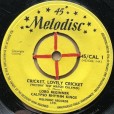
VG. Felt-tipped cross-hairs.
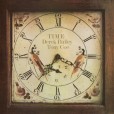
Multi-reedist Tony Coe was born in 1934, four years after guitarist Derek Bailey. He cut his teeth as a career jazzman with Humphrey Lyttleton, before an extended stint with the Kenny Clarke/Francy Boland Big Band. On this rare 1979 duo outing, he sticks to clarinet. And though that instrument has an illustrious jazz pedigree, Coe’s playing here is something else.
It’s worth noting that the clarinettist has also played under the baton of arch-modernist Pierre Boulez, the kind of composer Derek Bailey enjoyed taking to task in his book Improvisation. You might think the Frenchman’s uncompromising serialism and the free playing Bailey defended with such passion all his life would have little in common, yet both men were hugely influenced by Anton Webern. It’s an influence you can hear right through Bailey’s career in his obsessive exploration of tight parcels of registrally-fixed pitches, notably those trademark ringing harmonics. Meanwhile, Coe’s meandering semitones and sinuous arabesques here recall both Boulez’s clarinet writing in Domaines, and the harmonic world of Boulez’s own teacher Olivier Messiaen.
Still, no traditional classical musical notation could ever render the extraordinary rhythmic subtlety and timbral complexity of this music. It’s at one and the same time dazzlingly virtuosic — Coe and Bailey are on stellar form throughout, and have enough sense to, yes, accompany each other where needs be — and supremely lyrical and spacious.
An absolute delight.
Beau Wanzer and Shawn O’Sullivan.
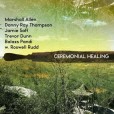
Marshall Allen, Danny Ray Thompson, Jamie Saft, Trevor Dunn, Balazs Pandi, Roswe
Ceremonial Healing
Rare Noise
The two Arkestra stalwarts in 2016 with rising star Jamie Saft on keys, bassist Trevor Dunn and drummer Balazs Pandi; also the great trombonist Roswell Rudd, in one of his very last recordings. Nicely presented.
A set of five throbbing, twinkling, oscillating excursions on analogue synth. Cosmic but intriguingly personable. Have a listen!
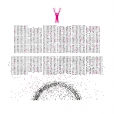
A second killer Trilogy EP from DJT in Japan, advancing the legacy of Chain Reaction.
Serious, emotionally reined-in music; structurally minimal, linear and open-ended, without the puppeteering routines of most dance music… but all the more enthralling and grooving, with hefty bass. The sense of monumental, weather-distressed, darkening dread is counter-balanced by this forward momentum, and expertly dubwise light-and-shade, with layered detail.
The reverberative, gong-like tolling of the opener gives way on the flip to machines starting up in a cavernous space, like vast beating wings, with a tumping bottom end, over nine minutes.
In-between is a more atmospheric and tentative interval, with slowly roiling synths and near-and-far, morse-code percussion.
Ace.
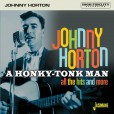
The first decent compilation, from the early honky tonk and rockabilly sides — total killers like the tanked-up, randy-as-a-stoat I’m Coming Home — through to the witty country hits.
‘Get your face all pretty and your hair done right / ‘Cos we’re gonna do the town tonight / Well I’m comin’ into town and right on time / I still got your lovin’ on my mind… Well I came to a hill and the truck looked down / Throwed in low and she’s huggin’ the ground / Scratchin’ gears but I’m goin’ again / I’m comin’ home baby / I’m doggin’ it in.’