















Your basket is empty

Honest Jon's has enrolled with the European Union 'Import One-Stop Shop'. For EU customers, this means that you will not be charged any additional VAT or duty, nor any handling fees. No further costs.

Clear vinyl.

‘It opens with hypnotic, dubwise low-end pressure; then Guess What pushes into Bristol techno territory. Next up the syncopated bass mutations of You’d Never Know; before Swollows Sunshine drifts into electro, ambient melancholy.’

‘A new album of category-scrambling song-craft by the elusive and shape-shifting Thomas Bush; the latest stage in a wayward path between everything from murky dirges to head-nodding laments to crystalline synths that hang precariously in the air over your new-favourite bass line.
‘Critical responses along the way have focussed on a predilection for the folkey-dokey, but judging from releases like 2026’s guld, Bush’s definition of ‘folk’ has as much to do with A Guy Called Gerald as it does with Shirley Collins or John Martyn.
‘For all its diversity, what unites Bush’s ever-expanding body of work is its dual commitment to experimentation and a job well done.’
“Random Constraint Satisfaction Problems was recorded at Vista Studio 1, Malmö, between 2022 and 2025. After creating an account at academia.edu for the purpose of reading a text now forgotten, I began to get emails asking me questions such as ‘Thomas Bush, did you write Brucellosis and Sacroiliitis: A Common Presentation of an Uncommon Pathogen?’, and ‘Are you the Thomas Bush who wrote ATR-dependent Phosphorylation of FANCA on Serine 1449 after DNA Damage is Important for FA Pathway Function?’, which began to make me wonder if I was, or if I wasn’t, perhaps I should be.
“The resulting work is an attempt to find meaning in this, and other chaotic and ambiguous situations through analysis using materials and equipment to hand. Being sensitive to signs and following them up with enthusiasm. Both source material and evaluation are presented.”
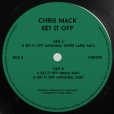
Ace, classic UK garage.
With the raw, vital, white-label mix.
Ruff.

His heady sophomore Blue Note, from 1969. Elvin Jones and Jimmy Lyons pick up where Ghetto Music left off. Funky grooves injected with a gospel street choir and late-sixties free-form freakery.
‘Classic Vinyl.’

Freddie in his heyday like this was one of the greatest singers in reggae history.
He’s in soaring, inspirational form here, riding a hard-as-nails Niney rhythm.
The organ-led dub is dazzling. Mark Ernestus from Rhythm & Sound recently opened a set with one of its incarnations, at the already-legendary Open Ground club in Wuppertal.
Both sides, classics.

A tough, funky, full-throated cross between raw boogie and Modern Soul, out of Jackson, Mississippi.
Ticking high hats school of Earl Young; bonkers bass.
Originally released by Joe Shamwell on his Shakin’ label, this was the Chymes’ first release, just prior to their deal with RCA.

Now available on vinyl at long last, a crucial retrieval from the revered Chain Reaction imprint, run by Basic Channel.
Originally out in 1999, on CD only, dedicated to the memory of Stephen Lawrence, this is an utterly assured, engrossing, deep blend of dubwise techno and Detroit-schooled ambient.
Beautifully presented, Basic Channel style, in a debossed sleeve constructed from recycled grey board, printed black on both sides. With a card for digital download. Remastered by Rashad Becker.
Warmly recommended.

Lash them, Tubby, lash them.
We ship worldwide. The postage rates for your order are displayed before payment, which is processed using Paypal. You can pay using your Paypal account or any of the following cards. No need to join Paypal.